

GS1-128 Barcodes in Java
Create GS1-128 shipping labels and trade item barcodes with Code 128 and application identifiers from Java.
How it works
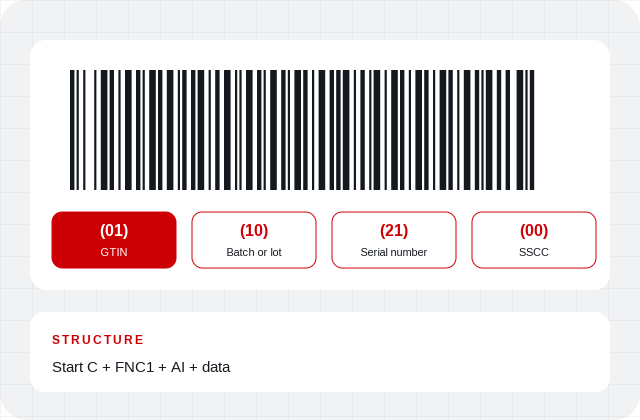
GS1-128 is built on Code 128 and encodes GS1 data structures such as SSCC-18 and SCC-14. Each symbol starts with a Start C character, then FNC1, then an application identifier whose data forms an element string.
- Common AIs: (00) SSCC, (01) GTIN, (10) batch or lot, (21) serial number, (8100) and (8101) coupon codes
- FNC1 can be entered as ~202 with ApplyTilde, as ASCII 202, or by using (01) with parentheses; variable-length strings go last and are separated by FNC1
- A MOD 10 check digit is often required: with ApplyTilde enabled, ~m followed by the count of preceding characters computes it
- The Java Code 128 class supports auto mode and GS1-128 AI detection
In Java
Parenthesized application identifiers work in Code 128, and tilde codes give explicit control of FNC1 and check characters.
BarCode bc = new BarCode();
bc.setDataToEncode("(01)09521101530001(10)ABC123");
// parenthesized AIs are accepted in Code 128;
// ~202 can be used for FNC1 when ProcessTilde is true
Frequently asked questions
What is GS1-128?
A barcode standard built on Code 128, formerly known as UCC-128 or EAN-128, used for shipping labels, trade items and coupons.
How tall should the symbol be?
Height is 15% of the symbol length or 0.50 inch (1.3 cm), whichever is greater, according to BarcodeFAQ. For 10 to 16 mil X dimensions use 0.50 inch; for 16 to 40 mil use 1.25 inches.
Where can I verify the data?
The Barcode Data Decoder Verifier App at IDAutomation parses the element strings.
Related GS1 pages
Learn more at BarcodeFAQ.com
The Internet Barcode FAQ explains GS1-128 in depth.